
St John Ogilvie
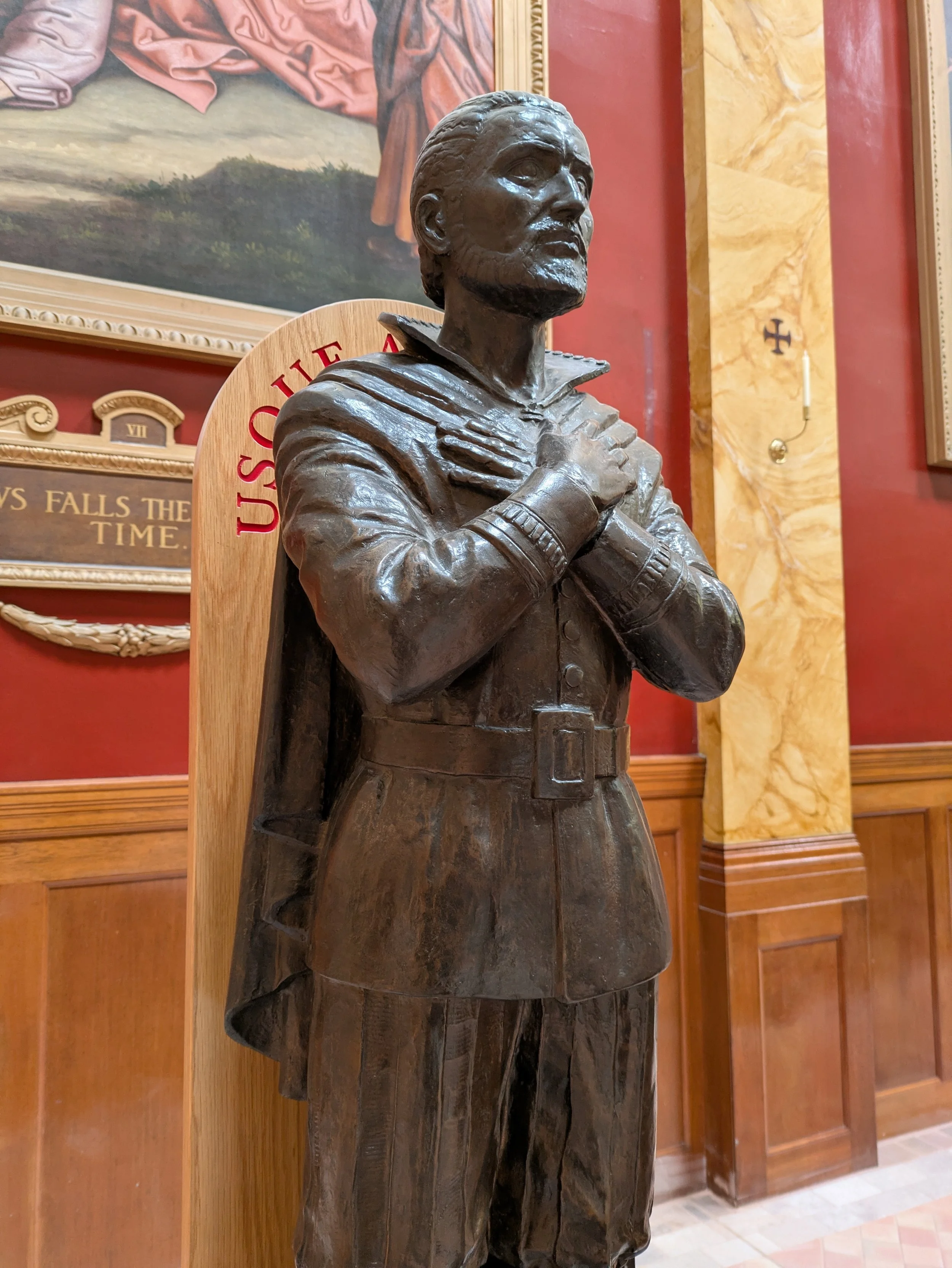
The bronze statue of St John Ogilvie is by Zeljko Kujundzic (left); made in 1946, for a new shrine in this church to honour the martyr of the Scottish Reformation.
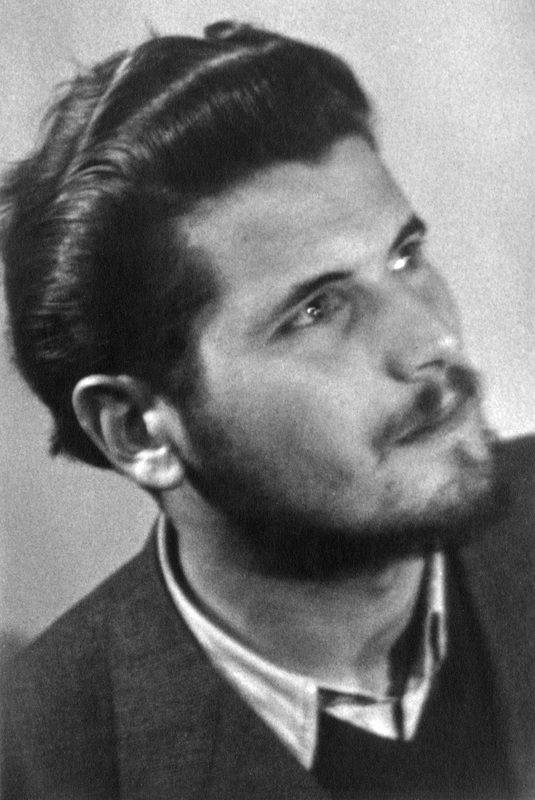
Zeljko Kujundzic was born in 1920 in Subotica in northern Serbia, of Turkish and Hungarian descent. He trained at the Royal College of Art in Budapest. When the Nazis occupied Hungary in 1944, he became active in the resistance, was caught and interned, escaping a labour camp only to be taken prisoner by the advancing Soviet Red Army. He defected to the West in 1946, living and working for ten years in Edinburgh before settling in Canada and the United States. Kujundzic died in 2003.
The fine marble bas-relief beneath the statue, of John Ogilvie landing at the port of Leith in November 1613, disguised as a horse trader and being welcomed in secret by fellow Catholics, is also by Zeljko Kujundzic; as are the two bronze candlesticks bearing images of St John Ogilvie and the traditional crossed palm branches - symbols of martyrdom (Revelation 7:9).
The present shrine, bringing back together the three elements of Kujundizic’s work was created in 2025. The oak panel bears the engrailled cross from the Ogilvie family coat-of-arms and the motto Usque ad finem - “And so to the end” - together with the year of Ogilvie’s martyrdom (1615) on the reverse.
The Ogilvie statue is the gift of Peter & Ellen Reilly and family (1946).
John Ogilvie was born in 1579 at Drum near Keith in Banffshire. At the age of 13, he was sent to the great Protestant school at Helmstadt but, as was usual at the time, soon moved on to other schools, coming under the influence of the Benedictines and Jesuits who taught him. In 1596, he entered the Scots College at Louvain. And there was received into the Catholic Church. Three years later he joined the Society of Jesus at Brno and, after studies, was ordained priest at Paris in 1610.
He was sent to teach at the Jesuit school at Rouen. But, after long years of absence from his home country, Scotland was never far from his thoughts and he yearned to serve the needs of the persecuted Catholic community there.
At his own request, Ogilvie was sent on mission to Scotland to support the oppressed Catholic community by celebrating the Mass and sacraments in secret. He landed at Leith docks in November 1613 under the alias of Mr John Watson, horse trader, knowing that even to be a Jesuit priest was a capital offence. Most of his work was done in Edinburgh, Renfrewshire and Glasgow. After less than a year, he was betrayed and arrested in Glasgow in October 1614.
Ogilvie remained in captivity until his execution on 10th March 1615 at Glasgow Cross. He was interrogated constantly, harried and tortured – one time he was kept awake for nine consecutive nights by being jabbed with sharp pins. Throughout his imprisonment he showed great courage and skill in defending his Catholic beliefs.
For maintaining the spiritual supremacy of the Pope, he was sentenced to death. On the scaffold at Glasgow Cross, he declared his loyalty to the King and protested that he was sent to his death ‘for religion alone.’
Before he was hanged, he threw his rosary into the crowd and prayed to Our Lady and the angels with invocations from the Litany of the Saints. The customary butchering of the body was not done due to the sympathy the watching crowd had for him. His body was hurriedly buried close to the churchyard of Glasgow cathedral
Ogilvie was declared a saint by Pope Paul VI in October 1976.
His feast day is celebrated on 10th March - the date of his martyrdom.